
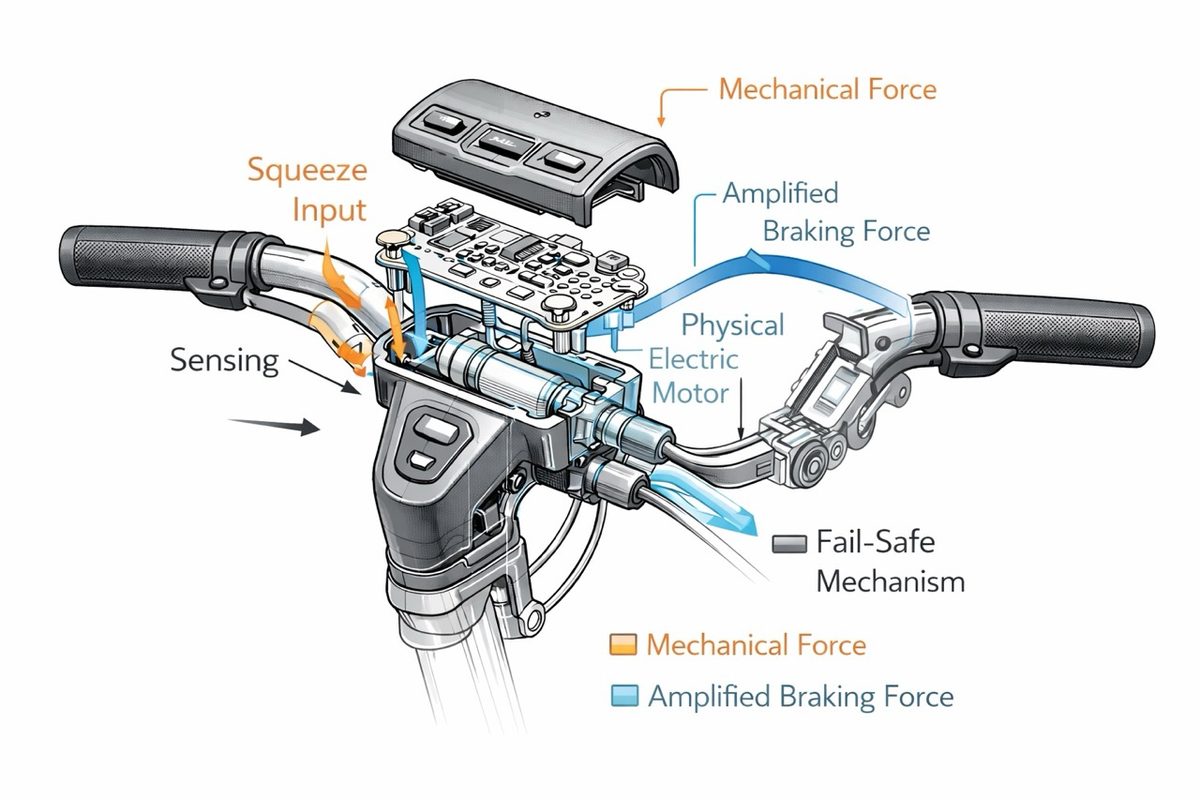
In a groundbreaking development, Dutch inventor Maas van Beek has introduced an electronic braking system that eliminates the need for traditional brake levers, potentially revolutionising over a century of bicycle design. This innovative system allows cyclists to decelerate by simply squeezing the handlebars, with no levers required.
Intuitive Braking Mechanism
Van Beek’s design integrates pressure sensors within the handlebar grips to detect the force of a cyclist’s squeeze. These sensors transmit the input to a central unit, which then activates the brakes accordingly. This approach enables braking from any hand position without the need to reposition fingers, enhancing safety and responsiveness.
Addressing Real-World Challenges
The inspiration for this system stemmed from a personal experience where van Beek found himself unable to reach the brake levers promptly during a critical moment. This incident highlighted the importance of immediate braking response, especially in emergency situations. By eliminating the need to move fingers to reach levers, the system offers a more intuitive and immediate braking experience.
Technological Integration
The system employs pressure sensors inside the handlebar to detect when a cyclist squeezes, sending this input to a central module that activates the brakes. A motor within the system amplifies the braking force, ensuring effective deceleration without requiring excessive pressure from the rider. Additionally, a mechanical backup is incorporated to maintain braking functionality in the event of electronic failure.
Potential Applications
While the system is particularly advantageous for performance road bikes, where levers may be out of reach when riding on the tops, van Beek envisions its application across various types of bicycles. He views this innovation as a broader reimagining of bicycle control, aiming to enhance safety and user experience for all cyclists.
Future Prospects
Currently, the system remains at the conceptual stage. Van Beek has filed a patent application and shared detailed designs but has yet to develop a working prototype. He is actively seeking collaborations with bicycle manufacturers and component suppliers to bring this innovative braking system to market, potentially marking a significant advancement in bicycle safety and design.
This development aligns with a broader trend in the cycling industry towards integrating electronic systems to improve performance and safety. As the market for electronic brake systems continues to expand, innovations like van Beek’s could play a pivotal role in shaping the future of cycling technology.