
At the 2026 Sea Otter Classic, three prominent brands—Sapim, Partington, and Gulo—unveiled innovative carbon spoke systems, each addressing common challenges in carbon wheel technology. These developments focus on enhancing serviceability, hub compatibility, and overall usability, alongside weight reduction.
Sapim RC-1: A New Entrant in Carbon Spokes
Belgian manufacturer Sapim, renowned for its steel spokes, introduced the RC-1, a fully pre-tensioned carbon spoke developed in collaboration with Applied Fiber, a U.S. company specializing in aerospace and defense technologies. Weighing 1.9 grams at 260 mm, the RC-1 is 3 grams lighter than the CX-Ray steel spoke and 1 gram lighter than Sapim’s own CX-Carbon. Sapim claims that the RC-1 adds vertical compliance to the finished wheel, enhancing ride comfort. Production equipment is being relocated to Belgium to manufacture these spokes in-house, initially focusing on OEM supply to wheel brands, with retail pricing yet to be announced.
Partington R-Series: Replaceable and Carbon
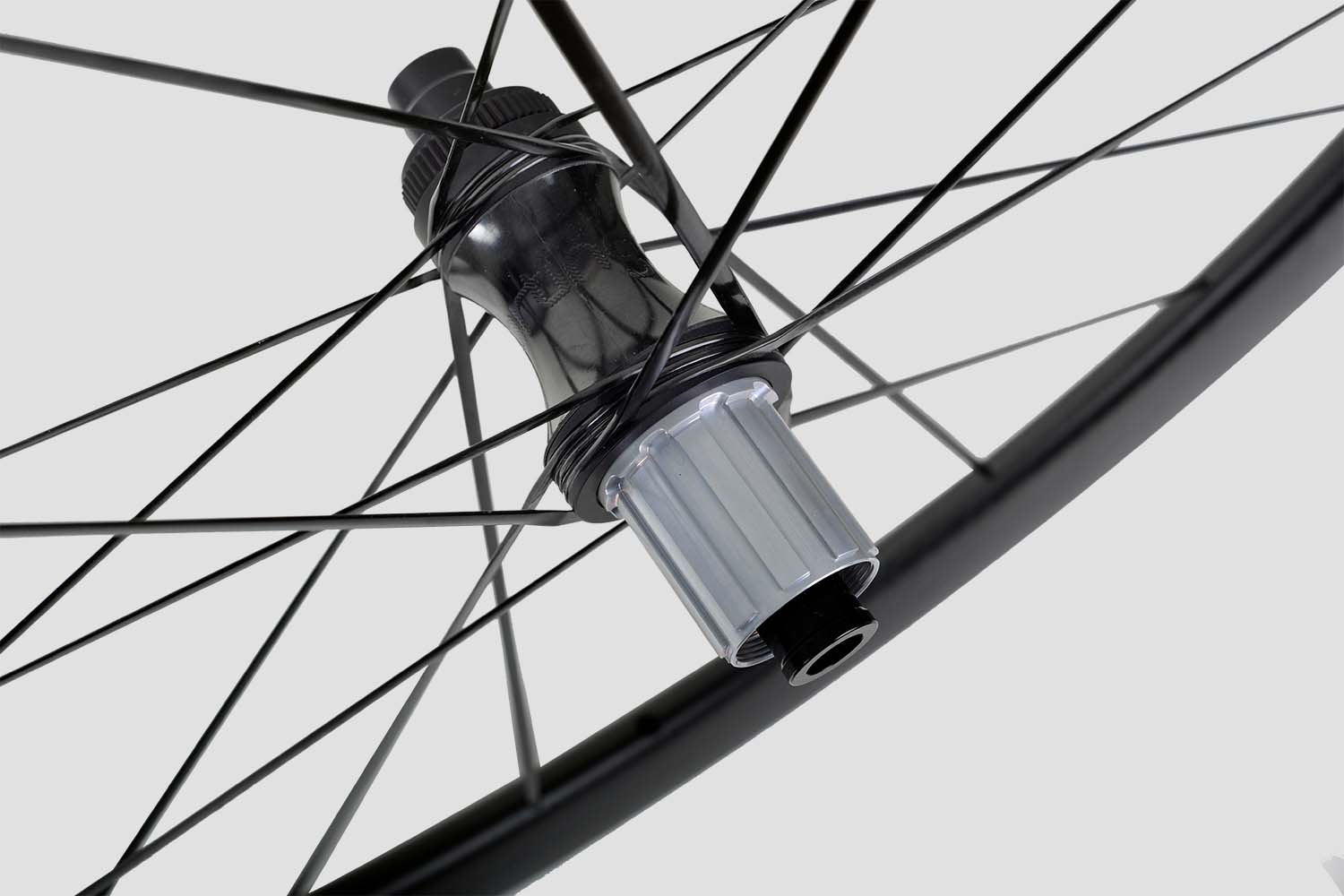
Australian brand Partington addressed the maintenance challenges of premium carbon spoke wheels. The previous R-Series MKII featured continuous carbon filaments running from rim to hub and back, embedded within the structure. While light and stiff, spoke damage rendered the wheel unusable. The new R-Series retains carbon but incorporates an eight-layer looped spoke design. On the hub side, the loop is secured with a pin that screws into the hub via an Allen key. This pin is eccentric, allowing limited tension adjustment. On the rim side, the spoke slides into a slot and is fastened with a locking mechanism, resulting in a closed rim bed that eliminates the need for tape for tubeless setups. The proprietary hub features a needle bearing as the main bearing, a helical spline ratchet with low resistance, and end caps made of PEEK plastic, which Partington claims is four times stronger than aluminum and gentler on carbon frames. Rim depths are available in 50 mm and 65 mm, with internal widths of 23 mm and external widths of 34 mm, optimized for 28-32 mm tires. Weights range from 1,175 grams (50 mm, Performance Ti) to 1,290 grams (65 mm, Performance). Prices start at $5,500 for the Performance and $6,500 for the Performance Ti version, with a launch date set for June 1.
Gulo G-Spoke: Broader Compatibility
While Partington developed a complete wheel platform, U.S. brand Gulo took a different approach by adapting its existing braided carbon G-Spoke to fit a wider range of hubs. The new straight-pull variant is compatible with any carbon spoke-compatible hub, such as those from Industry Nine, without requiring a proprietary hub. The spoke utilizes triaxially braided carbon with an additional material that Gulo considers proprietary. Both ends feature titanium hardware with an internal threaded nipple. Gulo claims a tensile strength of 900 lbs and 8% less vibration compared to steel spokes, along with higher impact resistance in their own drop tests. Complete wheels with the new straight-pull spokes are priced between $2,295 and $2,695. The lightest model, the GMX SL XC, weighs 1,035 grams with a 30 mm internal width.
Brand Highlights
- Sapim RC-1: 1.9 g per spoke, OEM-only, production in Belgium, retail price unknown.
- Partington R-Series: Replaceable continuous carbon spokes, adjustable tension, launching June 1, starting at $5,500.
- Gulo G-Spoke Straight-Pull: Fits standard carbon spoke hubs, titanium hardware, wheels starting at $2,295.
These three brands represent different approaches to carbon spoke technology. Sapim leverages its scale through OEM partnerships, Partington focuses on making high-end carbon wheels maintainable, and Gulo lowers the barrier by eliminating hub lock-in. Which approach will gain widespread adoption in complete wheelsets throughout 2026 remains to be seen.