
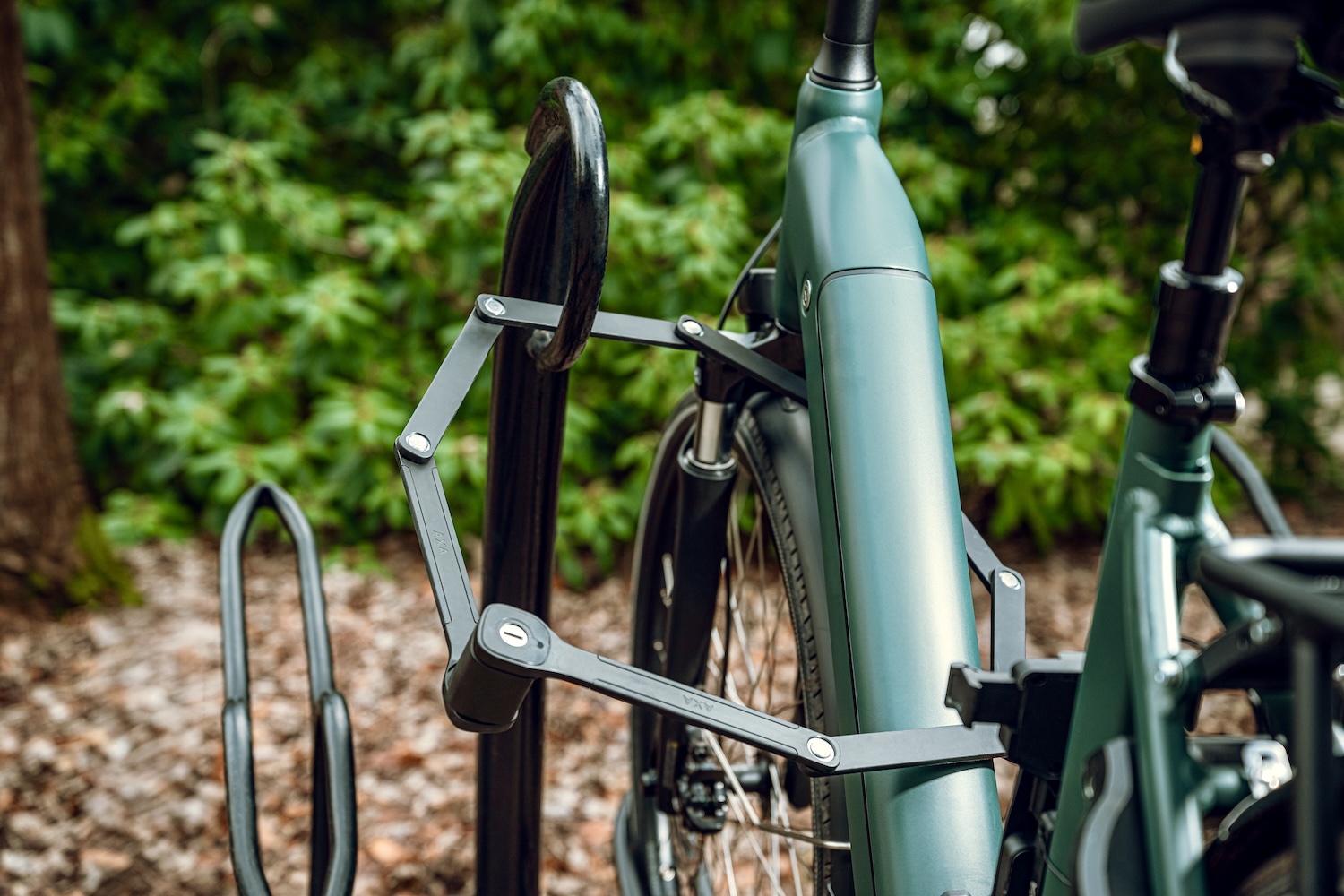
AXA Reinforces Confidence with the Fold 130 Folding Lock
In the ongoing battle against bicycle theft, the spotlight often falls on technological advancements and product development. However, according to Edward Hol, the real challenge lies elsewhere: behavior. The issue isn’t the lack of solutions but the inconsistent application of existing ones.
Allegion has recently introduced a new folding lock to the market, the AXA Fold 130, which combines security with user-friendliness and will replace the AXA Fold 90. With eight hardened steel links, the lock offers a locking length of 130 cm, allowing bicycles to be securely fastened to larger objects. The new click holder and the included AXA Fix ensure quick installation and safe transport. A hidden tracking tag compartment makes it easy to track your bike. The lock head can be clicked into place from any direction. A soft coating protects the bicycle frame from scratches.
“The beauty of this folding lock is that it’s longer while maintaining the same dimensions. It has two extra links. The links are made of hardened steel, which is not the case with all folding locks, making them relatively easy to cut through with a small saw,” explains marketing manager Peter Ververs.
On many bicycles, insurance companies often require a second lock. Allegion addresses this with the AXA Fold 130, aiming to ensure that the second lock is actually used. “The second lock is still too often sold with the idea: you need it, put it in the garage, and that’s it. But it needs to be used. That’s where the real gain lies,” says Edward Hol, Sales Director After Market at Allegion.
He draws clear parallels with previous behavioral changes in mobility. “It’s like the motorcycle helmet in the past. Initially, no one wanted it. It felt like an obligation. But eventually, it becomes normal, and no one thinks about it anymore.” He wants to achieve the same shift with the use of a second lock. “For insurers, it’s already interesting if 60% use it,” he explains. “But we want to reach that last 40%. Only then do you really make a difference.”
A significant reason for the lagging adoption is, according to Hol, the lack of ease of use. Traditional chain locks are often considered impractical. “They’re heavy, rattle on the bike, and get in the way. Those are exactly the complaints you keep hearing.” Therefore, he sees a clear shift in the market. “We notice that folding locks are currently growing strongly. You can neatly take them with you on your bike, they don’t rattle, and they stay securely fastened. That makes the difference in daily use,” continues Ververs. “People with a really nice e-bike they’ve invested a lot of money in. And then such a chain around the saddle post, it doesn’t look good.”
The use of folding locks is relatively new in the Netherlands but already well-established internationally. “In Germany, the folding lock is fully integrated,” says Hol. “Where we still often see a chain around the saddle post here, almost everyone has a folding lock on their bike there.” At the same time, he emphasizes that the Netherlands is not necessarily different in this regard. “You just see that each country has its own preference. In the United Kingdom and in America, U-locks are, for example, much more popular. So it’s not a matter of right or wrong, but of habit and familiarity.”
Within Allegion, active work is being done to further lower the thresholds. Innovation focuses not only on safety but also on ease of use and integration into daily cycling. “It has to be simple: open, close, and done. If something is too complicated, people won’t use it,” Hol knows. This translates into practical improvements such as rattle-free holders, more compact designs, and longer locks that offer more flexibility when securing the bike. New technologies also play a role. For example, holders are being developed in which tracking equipment can be integrated. “You can, for example, process an AirTag in the holder,” Hol explains. “It’s then neatly concealed, doesn’t rattle, and makes it possible to track your bike.” At the same time, he remains realistic about the limitations of technology. “It’s still a race between the bike thief and the manufacturer. If you leave a weak point, it will be found sooner or later. So you have to make sure the whole system is right.”
In addition to product development, Hol sees a clear role for retail. The way locks are presented and advised makes a big difference, according to him. “The dealer reaches the consumer. That’s where the story needs to be told.” He notices that the role of the bike shop is changing. “In the past, it was often the mechanic who helped out. Now you see more and more real salespeople, and they earn their margin precisely on accessories like locks, insurances, and bags.” There’s still a lot of potential in that, according to Hol. “A second lock is not only a safety product, it’s also a logical part of the sales conversation.” He emphasizes that good advice is essential in this. “If you take the time and really look at the customer’s needs, you can explain much better why such a second lock is important.�