
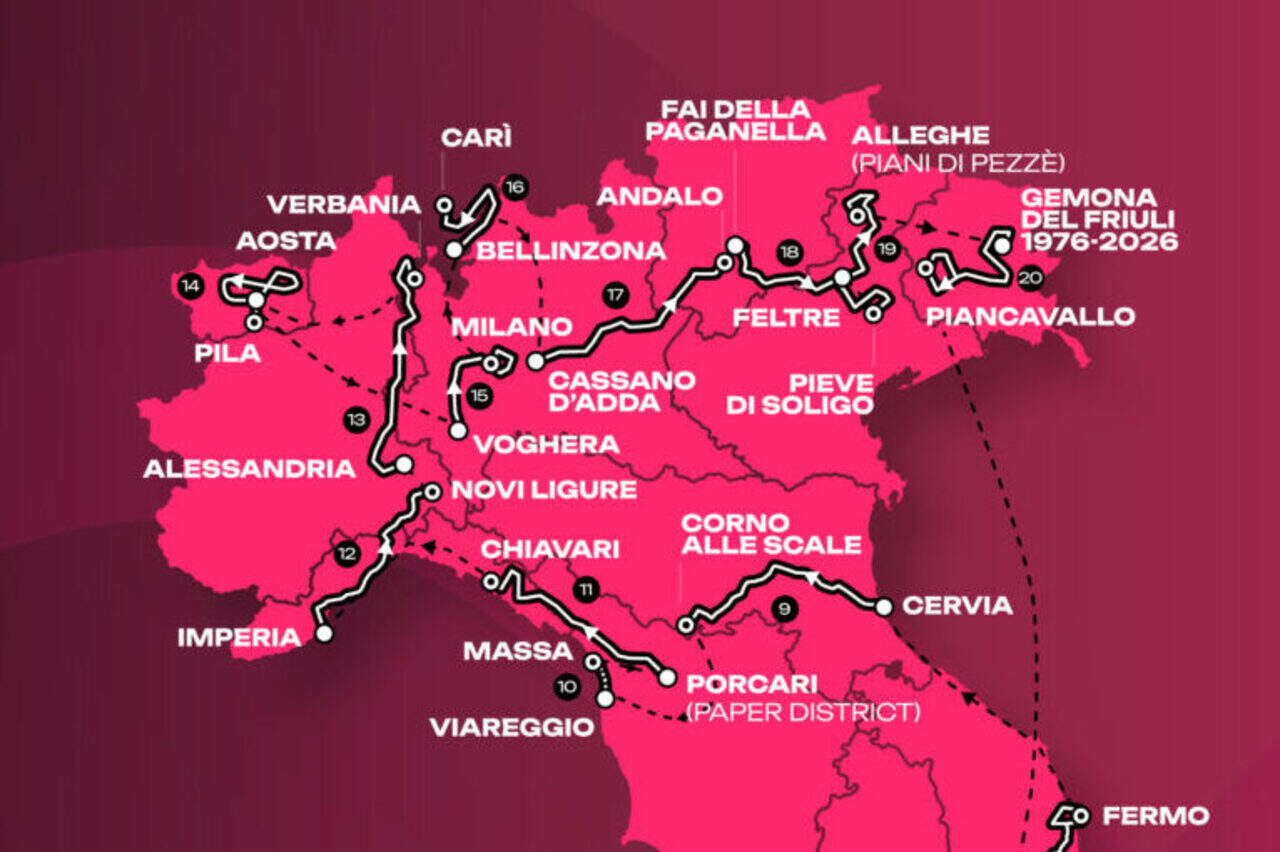
The 2026 Giro d’Italia is set to challenge riders with five formidable climbs that could significantly influence the general classification. Here’s an in-depth look at these decisive ascents:
1. Stage 14: Pila (Saturday, May 23) – Valle d’Aosta
- Climb Details: 16.5 km with an average gradient of 7.1%, peaking at 11%.
- Elevation Gain: 1,173 meters.
- Description: After a 30-year hiatus, Pila returns to the Giro via a new approach from Gressan. This steady ascent culminates at 1,800 meters, offering panoramic views of the Alps. The climb’s consistent gradient demands sustained effort, making it a true test of endurance. Historically, Pila has been a battleground for climbers, with notable victories by Robert Millar in 1987 and Udo Bölts in 1992. (cyclingnews.com)
2. Stage 16: Carì, Canton Ticino (Tuesday, May 26) – Switzerland
- Climb Details: 11.7 km with an average gradient of 8%, reaching up to 13%.
- Elevation Gain: 932 meters.
- Description: The Giro ventures into Switzerland, crossing into the Canton Ticino to tackle the ascent to Carì. This climb is reminiscent of the steep gradients found in the Giro di Svizzera, with previous winners including Darwin Atapuma in 2016 and Adam Yates in 2024. Its challenging profile is expected to shake up the general classification. (cyclingnews.com)
3. Stage 18: Cà del Poggio, Treviso (Thursday, May 28) – Veneto
- Climb Details: 1.1 km with an average gradient of 12.3%, peaking at 19%.
- Elevation Gain: 140 meters.
- Description: The Muro di Cà del Poggio is a short but brutal climb located in the Prosecco hills. Its steep gradients are akin to the famed climbs of northern Europe, offering a stern test for riders. Since its introduction to the Giro in 2009, it has become a regular feature, with its steep gradients often influencing race outcomes. (cyclingnews.com)
4. Stage 19: Passo Giau, Dolomites (Friday, May 29) – Veneto
- Climb Details: 9.9 km with an average gradient of 9.3%, reaching up to 14%.
- Elevation Gain: 922 meters.
- Description: At 2,305 meters, the Passo Giau is one of the most demanding climbs in the Alps. The ascent from Selva di Cadore is relentless, with no flat sections to offer respite. Its challenging nature has seen climbers like José Manuel Fuente and Egan Bernal conquer it in the past. In 2026, this climb is expected to be pivotal in determining the race leader. (cyclingnews.com)
5. Stage 20: Piancavallo (Saturday, May 30) – Friuli Venezia Giulia
- Climb Details: 14.5 km with an average gradient of 7.8%, with the first half being the most demanding.
- Elevation Gain: 1,131 meters.
- Description: Piancavallo serves as the final mountain stage before the race concludes in Rome. The climb begins steeply, averaging 9.4% for the first 6.5 kilometers, before easing slightly. Its history includes memorable performances by Marco Pantani in 1998 and Mikel Landa in 2017. In 2026, Piancavallo will be the last opportunity for riders to make significant time gains or losses before the final stage. (cyclingnews.com)
These five climbs are set to be the defining moments of the 2026 Giro d’Italia, each offering unique challenges that could reshape the general classification.
For a visual breakdown and further insights into these decisive climbs, you might find this video informative:
This is where you win (or lose) the 2026 Giro: the 5 decisive climbs