
For years, discussions about cycling mobility have predominantly focused on the development of dedicated bike lanes. This emphasis is understandable: without secure infrastructure, it’s challenging to envision a significant shift towards daily bicycle commuting.
However, a critical yet often overlooked aspect emerges upon examining the habits of daily cyclists: the necessity for secure bicycle parking. A bicycle isn’t merely a means to traverse the city; it must also be safely stored upon reaching its destination.
This concern affects both current cyclists and potential riders. Experienced cyclists frequently grapple with the recurring question: “Where can I park my bike?” Prospective cyclists often hesitate to start, not due to a lack of interest or means, but because of the fear that their bicycle might be stolen or damaged.
To genuinely increase the proportion of daily commutes by bicycle, constructing new bike lanes isn’t sufficient. The quality of the cycling experience must encompass the entire journey, including the moment the cyclist dismounts.
Convenience Alone Isn’t Enough
The bicycle is arguably the most economical urban transport mode. It requires no fuel, doesn’t incur road taxes, and doesn’t mandate compulsory insurance. Economically, it often outshines other transportation options.
Yet, mere savings don’t alter people’s habits. The decision to use a bicycle hinges primarily on how seamlessly it integrates into daily life. When determining where to park becomes complicated, or when the risk of theft accompanies every errand or workday, economic advantages become secondary.
Cycling mobility truly thrives when it ceases to generate uncertainty.
From Parking to Certainty
In this context, the experience of Weelo stands out. Weelo addresses parking not as an ancillary service but as an essential component of cycling mobility.
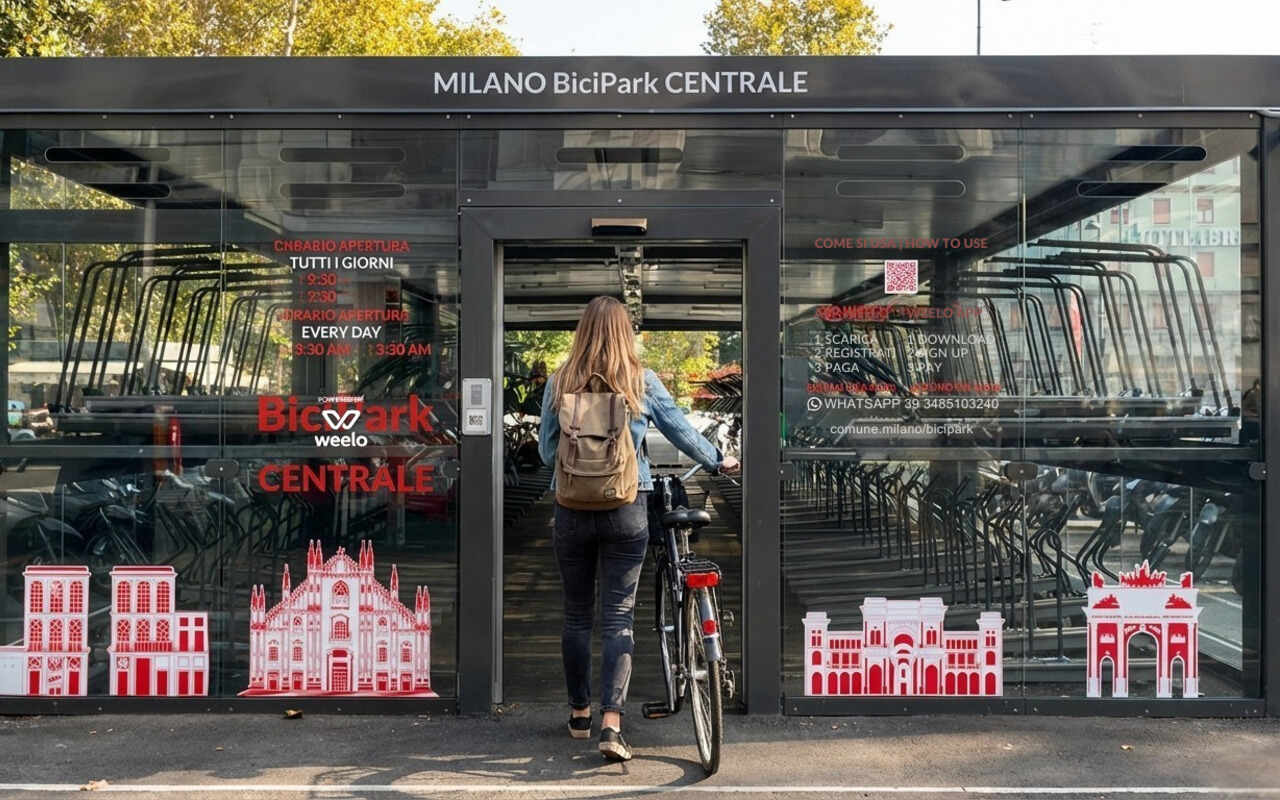
The concept is straightforward: transform parking from a potential weak point in the journey to a reliable element of the entire route. Weelo Bike Parking facilities are secure, video-monitored spaces accessible via a mobile application, allowing cyclists to park their bicycles safely without the need for physical keys or cards.
Beyond the primary function of secure bicycle storage, these facilities offer services tailored for regular cyclists, such as e-bike charging stations, repair and inflation stations, and spaces designed for larger vehicles, including cargo bikes and special bicycles.
The principle is simple: arrive at your destination, park swiftly, and continue your day without the constant worry about your bicycle.
A Service for All: Integration with Public Transport
One of the most compelling aspects is the relationship between bicycles and public transport. In many European cities, the growth of sustainable mobility hinges on the ability to integrate different modes of transport within the same journey.
When reliable solutions aren’t available near a train station or interchange hub, users tend to choose a single mode for the entire trip. Conversely, the presence of secure parking makes it more natural to combine bicycles, trains, and local transport.
A National Network for Bicycle Parking
The distinguishing feature of the Weelo project isn’t the individual parking facility but the network that connects diverse structures within a unified system.
The goal is to build a national infrastructure dedicated to cycling mobility, composed of recognizable points accessible through the same account, regardless of the city you’re in.
The network is already present in numerous Italian regions, from the main metropolitan hubs in Lombardy to cities in Veneto, Emilia-Romagna, and Abruzzo, extending to South Tyrol and Puglia. This expansion encompasses train stations, airports, universities, urban centers, and tourist destinations.
For users, the advantage is immediate: relying on the same user experience in different contexts without having to learn new rules and procedures each time.
When Bicycles Become a Normal Choice
The widespread adoption of bicycles doesn’t solely depend on the quality of communication campaigns or individuals’ environmental sensitivity. It primarily depends on how easily it can be incorporated into daily life.
Simplicity encompasses everything that happens before departure and after arrival. When parking a bicycle becomes easy, when intermodality functions without obstacles, and when safety is no longer an unknown, the bicycle stops being perceived as an alternative. It becomes simply one of the most natural options for getting around.
In this regard, the transition from the traditional pole to which bicycles are tied to a national network of Bike Parking tells us something deeper than the mere evolution of a service. It narrates the maturation of Italian cycling mobility, increasingly less tied to individual initiative and more aligned with an infrastructure capable of supporting the daily commutes of a growing number of people.
[Content created in collaboration with Weelo, which participated in the latest edition of Velo-city]