
Embarking on My First Solo Bikepacking Adventure: A Journey of Discovery and Resilience
On a serene Tuesday morning, June 16, 2026, just before 7:00 AM, I set out from home for my inaugural solo bikepacking expedition. Equipped with a modest under-saddle bag, a handlebar bag, and a central frame bag—which proved invaluable for keeping essentials within easy reach—I was ready to redefine my understanding of “necessity.” This journey was not just about the physical load but also about shedding the mental clutter that often accompanies our overanalyzed lives. It was this desire for simplicity and clarity that propelled me onto the saddle.
The prospect of spending the day pedaling through diverse landscapes, observing the world around me, and embracing the unknown was both exhilarating and motivating.
Exploring the Seriana Valley Cycle Path
I began by traversing the Seriana Valley Cycle Path, which guided me to the town of Clusone. From there, I descended towards Lovere, discovering a route I had never taken before. This path led me through the upper part of the town, passing through five tunnels previously unknown to me. These tunnels offered fleeting glimpses of the lake, providing a sense of discovery just 30 kilometers from home—a feeling that would accompany me throughout the journey.
Along the Oglio River: A Blend of Nature and History
Reaching Costa Volpino, I veered towards the Oglio River, joining the Oglio Cycle Path. This trail stretches 280 kilometers from Ponte delle Chiaviche in Mantua to the Tonale Pass, following the river’s course. The Oglio River, my first waterway companion on this trip, would be joined by others like the Noce, Adige, and Avisio as the journey progressed.
In its lower reaches, the Oglio is wide and slow-moving. As I pedaled upstream, it became narrower, more turbulent, and unpredictable, necessitating containment near urban areas. Along the path, I encountered beautifully maintained relaxation areas and archaeological sites, such as the Minerva Sanctuary near Breno. Although the archaeological park was closed, glimpses of the statue of the goddess added a touch of magic to the place.
Architectural Wonders and Serendipitous Encounters
The journey unveiled well-preserved Roman and medieval architecture in various towns, including the Federici Tower in Sonico. The inscription “Post tenebras lux” on its sundial resonated with me, symbolizing hope and renewal—a fitting message as I embarked on this personal journey during a transitional period in my life.
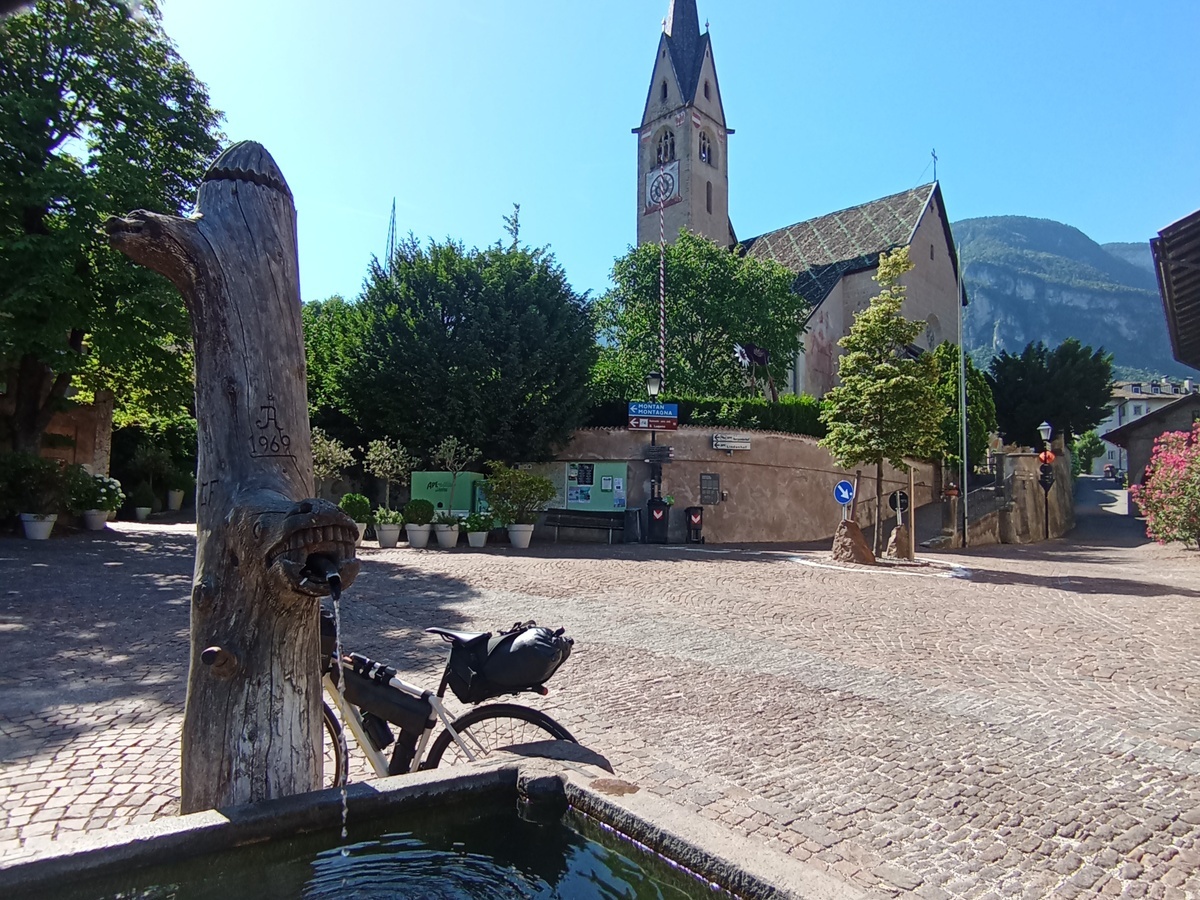
In the quaint village of Mù, I paused to refill my water bottle at a charming square with a bubbling fountain. A discreet sign indicated the direction to the Tonale Pass. As I looked across the square, I noticed its counterpart pointing towards the Po River. These signs, though simple, evoked a profound sense of being “on the road,” traversing paths less traveled, yet always present to guide travelers from one place to another, offering a brief respite in the daily lives of locals before immersing oneself back into the journey’s rhythm.
The Balance of Effort and Wonder
Cycling is both demanding and awe-inspiring. Observing the surroundings, marveling at the scenery, and then moving on to the next discovery mirrors the transient nature of life itself—a continuous flow of experiences, each moment giving way to the next.
Incudine: A Car-Free Haven
Arriving in Incudine, I met Lina, a local woman out for an afternoon walk with her dog. We struck up a conversation, and she shared insights about the village’s unique charm. Most houses were well-maintained, with one recently renovated. As I prepared to photograph it, Lina mentioned, “You probably don’t like that house, do you? Have you seen how they’ve done the roof?” I replied, “Actually, I like the flowers in front.” “Ah, I planted those,” she smiled. Lina explained that while some houses were rented out to visitors, the majority were owned by foreigners who spent a few months each year in this car-free part of the village. She herself split her time between Incudine and Milan. This encounter warmed my heart, reminding me of the simple joys found in unexpected conversations.
Towards the Tonale Pass and Higher Altitudes
The following morning, with the air fresh and clear, I resumed my journey towards the Tonale Pass. From there, a descent led me to Vermiglio, where a grassy trail connected me to the Noce River Cycle Path, winding through the Val di Sole. This picturesque trail meandered along slopes dotted with freshly mown meadows, where tractors busily turned hay into neat rows.
As I descended the valley, I entered a region marked as the “bear zone,” with signs advising appropriate behavior. Uncertain of the exact guidelines, I decided to pedal a bit faster through this area, preferring to keep moving.
Val di Non and Val di Sole: A Tapestry of Nature and History
The cycle path continued, revealing the apple orchards of the Val di Non. In the distance, the bell tower of Cles stood out, and the Noce River formed the Santa Giustina Lake, a large reservoir. Riding along the state road, I found myself alongside the imposing dam wall, with the vast emptiness on the other side—a moment that sent a shiver down my spine.
The day’s ascent culminated at the Tonale Pass. Descending into the Val di Sole, I reached Mostizzolo, where the cycle path ended, and I faced approximately 20 kilometers of state road. By now, it was just past noon, and the temperature had risen significantly. The Piana Rotaliana was particularly warm before I joined the Adige River Cycle Path.
Through Vineyards and Medieval Villages
Pedaling through the Piana Rotaliana, I navigated roads winding through vineyards thriving in this sheltered environment, protected from cold winds by the surrounding rocky cliffs. In June, the daily temperature variation allowed for nights below 20 degrees Celsius and days reaching 35 degrees, ensuring restful sleep in Egna, where I decided to spend the second night.
The next morning, I traversed the medieval center of Egna, one of Italy’s most beautiful villages. Riding through its characteristic arcades, protruding balconies, and splendid courtyards, I couldn’t ignore the steep climb ahead, classified as HC (Hors Catégorie), one of the most challenging.
The Former Val di Fiemme Railway
This ascent led me to the former Val di Fiemme railway cycle path: a 14-kilometer stretch of gravel from Montagna (above Pinzano) to the San Lugano Pass. Once past this section, the rest of the route would be on asphalt.
Towards the Dolomites: A Restored Peace
From Cavalese, I continued along the cycle path adjacent to the legendary Marcialonga Trail, passing through sites of the Milan-Cortina Olympics. As I encountered the Olympic logo on the asphalt, I couldn’t help but wonder about the future of these infrastructures now that the spotlight had faded.
Gradually, the valley opened up, and the cycle path ran alongside the river. Beyond the rooftops and orderly hills with their historic farmhouses nestled among lush meadows and dense fir forests, another incredible sight emerged: the limestone spires of the Dolomites.
These stone giants of the Val di Fassa, monumental walls now ting