
Cycling with Children: Ensuring Safe and Enjoyable Rides
Cycling offers families a healthy, sustainable, and enjoyable mode of transportation. For many, it’s an ideal way to navigate urban environments while spending quality time with their children. However, ensuring safety is paramount to make these experiences both positive and risk-free.
The Bicycle as a Family Mobility Alternative
In an era where sustainable mobility is gaining importance, bicycles present an attractive alternative to cars for families. Cycling with children reduces traffic congestion, decreases pollution, and promotes daily physical activity. Additionally, children develop responsible habits, gain autonomy, and foster a positive relationship with exercise from an early age. Many cities have enhanced bike lanes, secure parking, and traffic education programs tailored for cyclists of all ages.
Options for Transporting Children by Bicycle
Depending on the child’s age and the journey’s distance, there are various ways to transport them:
-
Child Seats: Suitable for children up to 22 kg (approximately 5 years old). They can be installed on the front or rear of the bicycle. Front seats allow for visual contact with the child but may limit pedaling space, while rear seats offer more comfort for the cyclist and better protection in case of a fall. It’s essential that these seats have a three or five-point harness, footrests, and a high backrest.
-
Child Trailers: Recommended for younger children, even from 1 year old, up to 6 or 7 years, depending on the model. They are very stable, spacious, and provide extra protection against wind or rain due to their covers. Trailers reduce the cyclist’s agility but offer safety and comfort, especially on long trips or for families with two children.
-
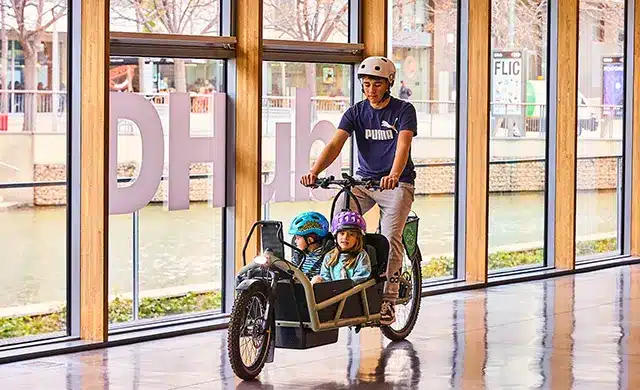
Cargo Bikes: Increasingly popular in urban settings, these bikes have a front or rear box where children sit with a seatbelt. They allow transporting multiple children simultaneously, backpacks, or even groceries. They are a safe investment that will accompany you for many years. Once you ride one, you won’t want to stop pedaling: they are the ideal alternative to cars in the city.
-
Tandem Bicycles or Tow Bars: Ideal for children who already pedal but still lack the autonomy to ride alone. The tow bar connects their bicycle to the adult’s, while in tandems, the child occupies the rear seat with adapted pedals.
Regardless of the chosen option, ensure the child always wears a helmet and is securely fastened.
Essential Equipment
Safety begins with selecting the appropriate equipment. The following items are fundamental:
-
Certified Helmet: Mandatory for individuals under 16 in Spain and recommended for the entire family. It should fit well and be positioned correctly, covering the forehead.
-
Front and Rear Lights: Mandatory at night and highly recommended during the day.
-
Fenders and Chain Guards: Prevent clothing or backpacks from getting caught.
-
Gloves and Glasses: Protect in case of a fall and against insects or dust.
Additionally, if transporting a child in a seat, trailer, or cargo bike, consider adding an adjustable safety harness, footrests with straps, and waterproof covers or canopies in case of rain.
Teaching Children to Be Responsible Cyclists
It’s not just about equipment; education plays a crucial role. The sooner children learn to respect traffic rules, the safer they will feel. Some practical tips include:
-
Start in Safe Areas: Parks, closed circuits, or greenways are perfect for practicing without traffic.
-
Learning Through Play: Basic signals (stop, left, right) can be taught in a playful manner.
-
Clear Routines: Look both ways before crossing, stop at traffic lights, and keep hands on the handlebars.
-
Adult Example: Children imitate what they see. If the adult respects traffic lights, signs, and wears a helmet, the child will assume it’s the norm.
Planning the Route: Safety First
Improvisation is not advisable when cycling with children. Planning the route minimizes risks and makes the journey more enjoyable. Key aspects to consider:
-
Prioritize Bike Lanes: Whenever possible, choose routes with safe infrastructures.
-
Assess Weather Conditions: Strong winds or heavy rain can make the journey dangerous.
-
Regular Breaks: Children need to rest more often. Including parks or green areas along the way makes it more pleasant.
The Benefits of Cycling with Children
Beyond safety, it’s worth remembering why more and more families choose bicycles as their regular mode of transport:
-
Physical Health: Both adults and children exercise naturally.
-
Emotional Well-being: Spending time cycling strengthens family bonds.
-
Traffic Education: Children learn mobility rules from an early age.
-
Environmental Respect: They grow aware of the importance of sustainable mobility.
-
Economic Savings: Compared to cars, bicycles don’t require fuel and have low maintenance costs.
Cycling with children is possible, safe, and highly enriching when done responsibly. If, after reading this article, you feel it’s time to take the step and pedal as a family, Central Bike offers children’s bicycles and equipment designed for each stage, with the peace of mind of having specialists who understand what it means to move safely.