
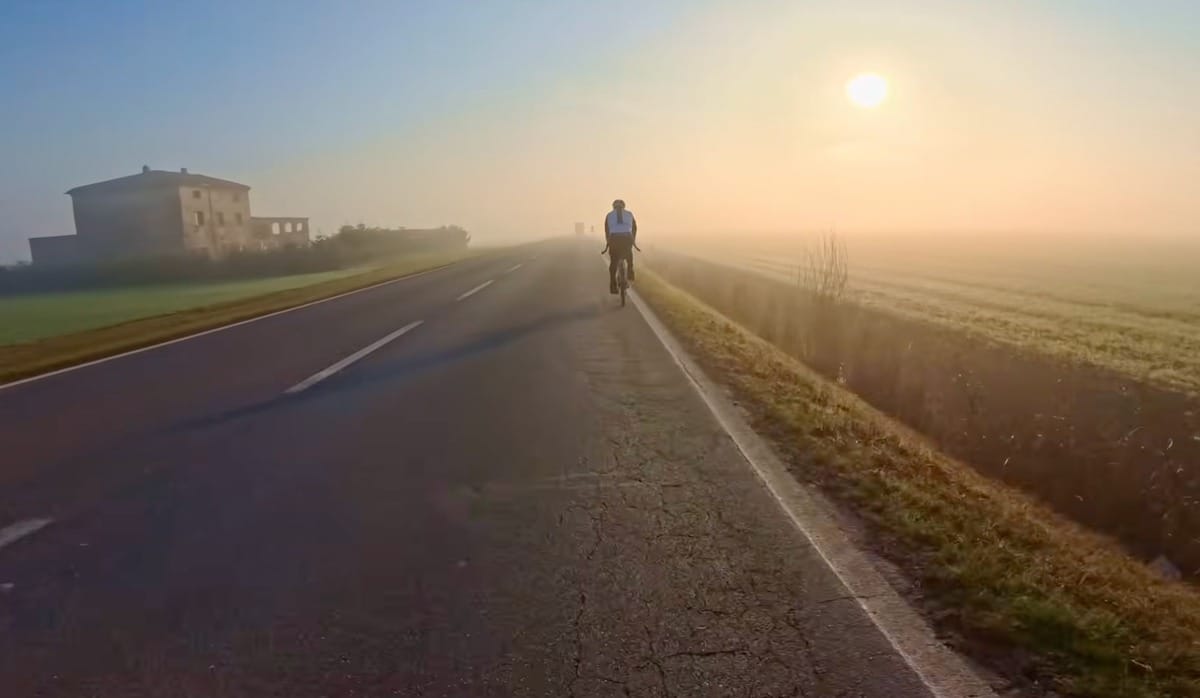
Pedalling Through History: Retracing Guareschi’s 1941 Journey
In the realm of cycling adventures, some journeys are born from spontaneous impulses, others from years of meticulous planning, and some remain unfulfilled dreams. Yet, when it comes to the bicycle, even those unachieved dreams can be resurrected, becoming legacies and desires that transcend generations.
Sergio Borroni, a seasoned cyclist and filmmaker, has long captivated audiences with his engaging travel narratives on YouTube, covering destinations from Myanmar to Morocco, and various European trails. In late 2025, Borroni embarked on perhaps his most poignant journey yet—not to a new geographical frontier, but to revisit a family story left unfinished. He cycled the path once traversed by Italian writer and journalist Giovannino Guareschi in 1941, a route his father had always dreamed of but never had the chance to experience.
Guareschi and the Bicycle: A Chronicle of the Land
In 1941, Giovannino Guareschi, born in 1908, traversed the Po Valley and northern Italy by bicycle, transforming his experience into a journalistic reportage published in six installments in Corriere della Sera. This was an Italy marked by war, where travel was slow, and the bicycle symbolized a vital form of freedom and direct observation of the land.
Guareschi’s narrative style was deeply immersive: each stop became a story, every encounter an experience. This approach to travel as a means of reading the world has captivated countless readers, connecting seamlessly with the family history at the heart of Borroni’s documentary.
Sergio Borroni’s Journey: Reviving an Interrupted Story
In his documentary, Borroni set out to complete the journey his father had longed to undertake. Approximately 85 years after Guareschi’s historical references, Borroni embarked on a path that had remained unfinished in his family.
The journey was not solitary. Accompanied by fellow cyclists Fabio Galli and Massimo Polidori—a cellist with the Orchestra of the Teatro alla Scala in Milan—and supported by the musical accompaniment of pianist Maria Grazia Fumagalli, the roads they traversed became a bridge between past and present, evoking ancient settings and a sense of continuity.
The route, as depicted in the documentary, began and ended in Milan, with Piazza Castello serving as both the starting and returning point. Along the way, the cyclists traversed the Po Valley, touching upon some of its most emblematic locations, including:
- Pavia: A city nestled between canals and plains, marking the first true departure from the city into the open countryside.
- Parma: The heart of the Emilian lowlands, rich in Verdi culture and rural landscapes.
- Brescello: Where the imaginary world of Don Camillo and Peppone comes to life between the square and the river.
- Reggio Emilia / Modena: The Via Emilia, a historic axis of passage.
- Bologna: The point of connection between the plain and the Apennines, a city of passage and connection.
- Rimini: The turn towards the Adriatic, between the coast and cycle paths.
- Ferrara: A city of water and bicycles, immersed in the embankments of the Po.
The return journey led back to Milan, completing a circular route that was not only geographical but also narrative.
The Bicycle as a Bridge Between Generations
Ultimately, the profound essence of the documentary lies in the bicycle’s ability to connect different eras. A dream can remain dormant for decades but does not cease to exist. It can be resumed, reinterpreted, transformed.
Borroni’s act is not merely the realization of a journey but a form of restitution. It is the way a family story becomes lived experience, and in which the bicycle reaffirms itself as something that goes beyond mere physical movement.
Because, after all, cycling also means this: transforming dreams into reality.