
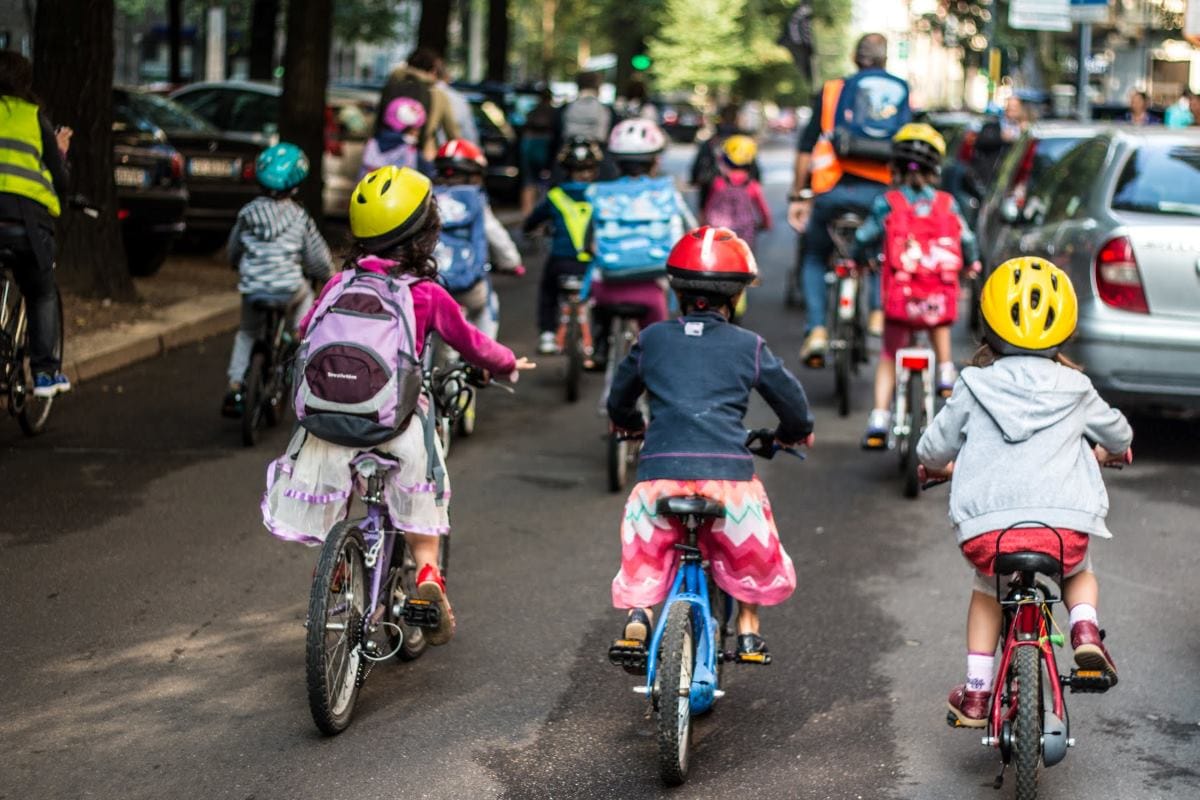
In recent years, Italian cities have faced challenges in promoting walking and cycling to school due to traffic congestion, road safety concerns, and ingrained habits favoring car use. However, several municipalities have initiated “bike to school” and active mobility programs to reduce traffic, improve air quality, and encourage healthier lifestyles.
Udine, a city in northeastern Italy, has emerged as a leading example of integrating sustainability, education, and public health into a cohesive project. The municipality has allocated €20,000 to fund initiatives that promote walking and cycling, aiming to serve as a model for other Italian cities. (ilpais.it)
Udine’s Initiatives
The €20,000 funding is directed towards sports associations and non-profit organizations that promote sustainable transportation, particularly for children and adolescents. Eligible projects include “pedibus” (walking school bus) and “bicibus” (cycling school bus) programs, road safety workshops, urban walks, and educational activities focused on cycling. Each project can receive up to €5,000 in support. (ilpais.it)
The municipality’s goal is clear: to transform daily movement into a habitual practice, not just a sporting activity. Encouraging car-free school commutes aims to reduce traffic and pollution, increase the autonomy of young people, and make the city more livable. (ilpais.it)
This initiative aligns with Udine’s broader strategy for sustainable mobility, evidenced by the growth of the city’s bike-sharing program and new urban projects dedicated to cycling. These efforts reflect a shift towards a city less dependent on private cars. (ilpais.it)
Bike Sharing Growth
The bike-sharing program in Udine has seen significant growth. In the first four months of 2026, rentals more than doubled compared to the previous year, with nearly 21,000 uses recorded. Electric bikes have been particularly popular, accounting for over 75% of rentals. (comune.udine.it)
National Context
The “bike to school” model is gaining traction in various Italian cities, though at different paces. Northern cities like Bolzano, Ferrara, and Treviso have developed extensive cycling networks and a stronger culture of sustainable mobility. Larger cities, such as Bologna, have expanded urban bike lanes and introduced projects like “Città 30,” implementing reduced speed limits in many urban areas to enhance safety for pedestrians and cyclists, especially near schools. (bikeitalia.it)
Despite these efforts, the national landscape remains fragmented. Many cities lack continuous bike lanes, safe connections, and structural investments. Often, projects start as temporary experiments and struggle to become a permanent part of urban mobility. (bikeitalia.it)
Udine as a Model
Udine’s project demonstrates that sustainable mobility is not only about the environment but also about quality of life, public health, and how urban spaces are experienced. Encouraging children and adolescents to move on foot or by bike helps build a different culture of the city, where the car is not automatically the only solution for every daily movement. (bikeitalia.it)
Naturally, adequate infrastructure is essential, particularly safe bike lanes and continuous investments. But projects that engage schools, families, and local associations are also crucial. Udine’s experience is particularly interesting in this regard: the attempt to transform active mobility into a concrete and shared habit. (bikeitalia.it)
In a country still heavily reliant on private car use, initiatives like this can become an important reference point. Change in cities often starts with the simplest actions, and the journey from home to school can be one of the first steps towards more sustainable mobility. (bikeitalia.it)
By investing in sustainable mobility and active transportation, Udine is setting a precedent for other cities to follow, demonstrating that a shift towards greener, healthier urban living is both possible and beneficial.