
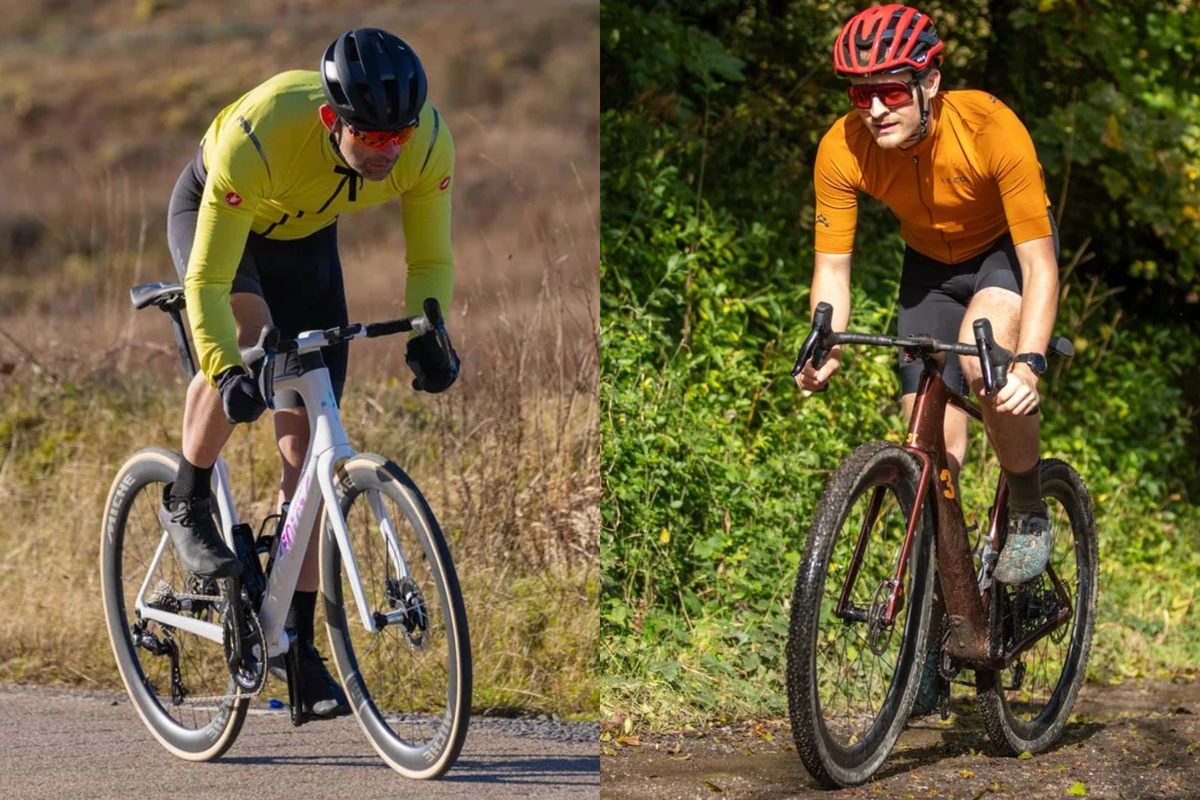
When choosing between a road bike and a gravel bike, understanding their distinct features is essential to match your riding preferences and terrain.
Frame Geometry and Riding Position
Road bikes are engineered for speed and aerodynamics, featuring aggressive geometries with steeper head tube angles and shorter wheelbases. This design positions riders in a forward-leaning stance, optimizing power transfer and responsiveness on smooth surfaces. In contrast, gravel bikes adopt a more relaxed geometry with slacker head tube angles and longer wheelbases, promoting stability and comfort over varied terrains. This setup results in a more upright riding position, enhancing control on uneven paths. (biketips.com)
Tire Clearance and Width
Tire clearance is a pivotal distinction. Road bikes typically accommodate tires up to 28mm or 32mm wide, suitable for paved roads. Gravel bikes, however, are designed with wider tire clearances, often supporting tires from 38mm to 50mm, and some models even up to 66mm. This allows for larger, knobbier tires that provide enhanced traction and comfort on unpaved surfaces. (cyclingweekly.com)
Gearing and Drivetrain
Gearing systems differ to suit their intended terrains. Road bikes are equipped with higher gear ratios, facilitating high-speed performance on flat roads. Gravel bikes feature lower gearing with wider-range cassettes, enabling riders to tackle steep and uneven off-road climbs effectively. Some gravel bikes also utilize single-ring drivetrains for simplicity and reliability in diverse conditions. (biketips.com)
Braking Systems
Both bike types commonly employ disc brakes, offering consistent stopping power. However, gravel bikes often come with wider tires and more robust frames, necessitating disc brakes to handle the increased forces and provide reliable braking on rough terrains. (bestbikebrands.com)
Mounting Points and Versatility
Gravel bikes are typically equipped with multiple mounting points for accessories such as racks, fenders, and additional water bottles, catering to long-distance touring and bikepacking. While some road bikes include mounting options, they are generally fewer, reflecting their focus on performance and weight savings. (bestbikebrands.com)
Conclusion
In summary, road bikes are optimized for speed and efficiency on paved surfaces, making them ideal for racing and fast-paced road cycling. Gravel bikes, with their versatile design, are suited for riders seeking adventure across diverse terrains, offering comfort and stability on unpaved paths. Your choice should align with your riding goals and the environments you plan to explore.