
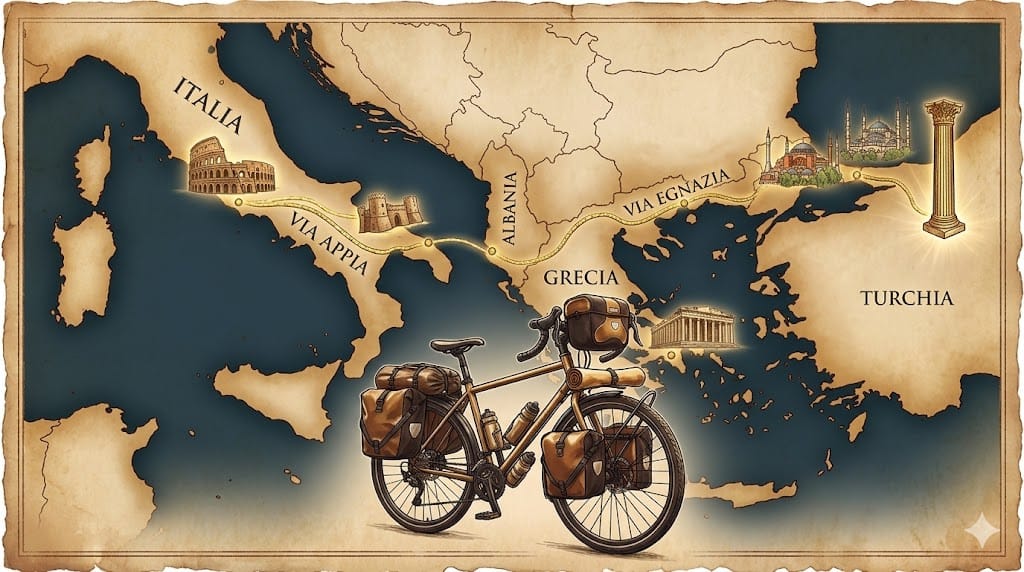
Turkish media welcome the return of Italian genius with I-Deha – News from Embassies – Ansa.it“La Colonna della Civiltà”: A Modern Odyssey from Rome to Istanbul
In the annals of history, certain routes have transcended mere geography to become symbols of cultural exchange and human endeavor. One such path is the ancient corridor connecting Rome to Constantinople, now Istanbul—a testament to the enduring ties between the West and the East. In 2026, this historic axis is being reimagined through “La Colonna della Civiltà,” a pioneering cycling journey that retraces the footsteps of ancient merchants, soldiers, and pilgrims.
Embarking on a Two-Millennia-Old Trail
The journey begins in Massafra, a town in the Taranto province of Italy, and follows the Via Appia, known as the “Queen of Roads.” This initial stretch symbolizes a deep connection to the land and the legacy of the Western Roman Empire. The route then crosses the Adriatic Sea from Brindisi to Valona, entering the Balkans and traversing Albania, North Macedonia, Greece, and Turkey’s Thrace. This path historically facilitated the confluence of Latin, Greek, and Byzantine cultures.
A Tapestry of Cultures and Histories
“La Colonna della Civiltà” is more than a physical journey; it is a cultural odyssey through four distinct worlds: Italy, the Balkans, Greece, and Turkey. Each region offers a unique historical and cultural landscape, making the slow-paced bicycle tour an immersive experience in understanding the intricate tapestry of the Mediterranean.
The Journey’s Milestones
The expedition is marked by several significant milestones:
-
Massafra to Brindisi: The journey commences in Massafra, traversing the heart of Puglia, and concludes the Italian segment in Brindisi, where the Adriatic crossing begins.
-
Brindisi to Istanbul: After crossing the Adriatic, the route winds through the Balkans, passing through cities like Apollonia, Elbasan, Struga, Ohrid, Thessaloniki, Kavala, and Alexandroupoli, before reaching Istanbul.
-
Istanbul: The journey culminates in Istanbul, near the Milion, an iconic landmark of ancient Constantinople, symbolizing the completion of the odyssey.
Symbolic Elements of the Journey
Central to the journey are two symbolic elements:
-
The Scrolls: These serve as a “symbolic passport of the bicycle,” stamped by municipalities, sports associations, and cultural organizations along the route. Each stamp represents a micro-testimony of passage and hospitality, emphasizing the reciprocal nature of the journey.
-
The Column: Inspired by Roman milestones, this column accompanies the expedition and is to be delivered to a local cycling association in Istanbul, near the Milion. This act symbolizes the completion of the narrative circle—from Rome to “New Rome,” traversing empires, languages, and centuries.
Cycling as a Cultural Infrastructure
Beyond the athletic challenge, “La Colonna della Civiltà” embodies a significant trend in European cycle tourism. It utilizes the bicycle as a key to understanding the geopolitical and cultural landscape of the region. The project aims to:
-
Highlight Historical Connections: Emphasize the continuity between the Via Appia and Via Egnatia as a unified historical axis.
-
Promote a Transnational Cycle Path: Advocate for the development of a future transnational cycle route from Rome to Istanbul.
-
Strengthen Local Communities: Foster cooperation among local communities through the passage of cyclists, promoting cultural exchange and mutual understanding.
The overarching message is clear: the Mediterranean is not merely a political geography but a network of historical relationships still active today. The bicycle, with its inherent slowness, becomes the most suitable means to make these connections visible and tangible.
Conclusion
“La Colonna della Civiltà” is more than a cycling journey; it is a modern odyssey that bridges continents, cultures, and histories. It invites participants to experience the Mediterranean’s rich tapestry firsthand, fostering a deeper appreciation for the shared heritage that unites Rome and Istanbul.