
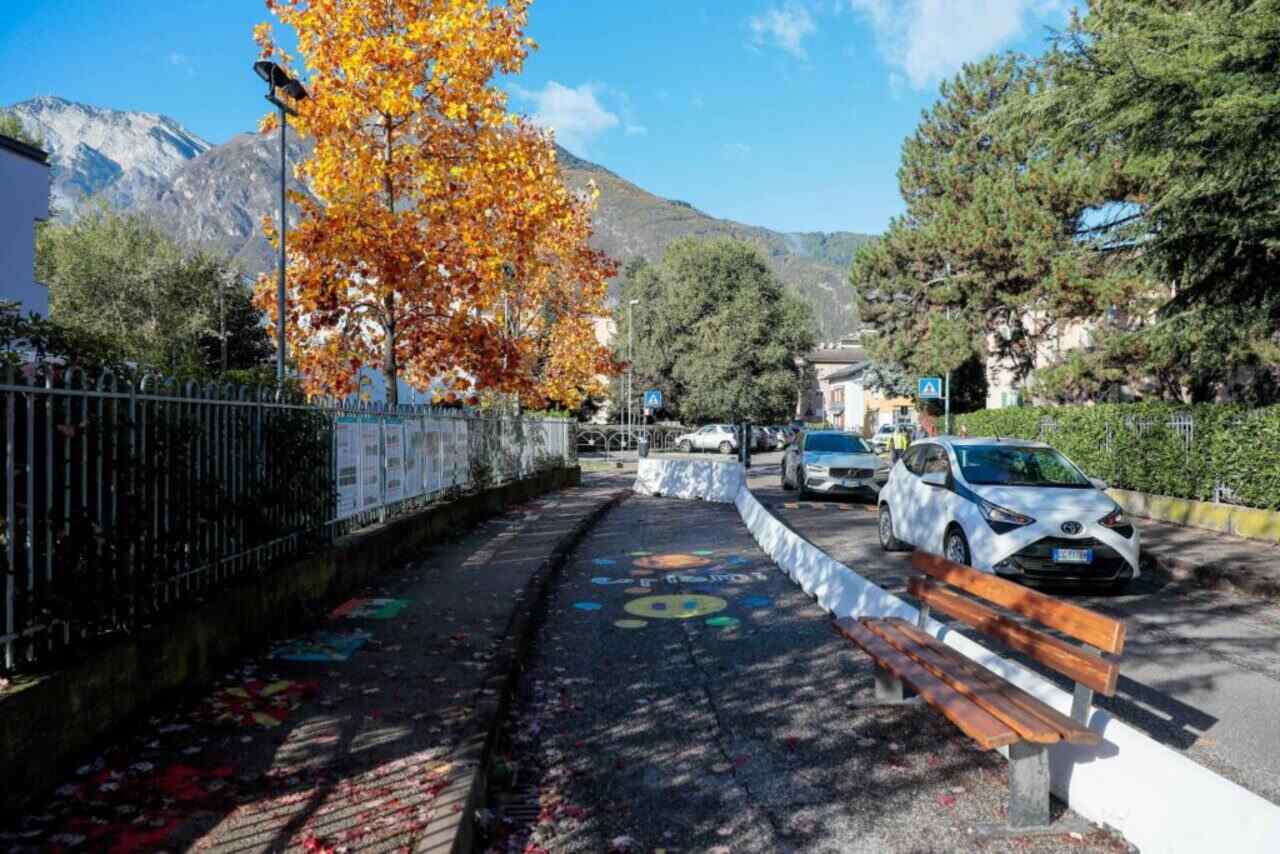
Via Anna Frank, Trento
In the Clarina district of Trento, Italy, Via Anna Frank—a narrow, residential street adjacent to a public garden and serving as a primary route to a local elementary school—has undergone significant changes to enhance safety for children. Previously, the street allowed two-way traffic with parking permitted on one side, despite its width being only 7 meters, leading to various safety concerns, especially during school drop-off and pick-up times. These issues included irregular driving behaviors, difficulty in vehicle passing, parking on sidewalks, and insufficiently wide sidewalks with numerous architectural barriers.
At the end of Via Anna Frank is the barracks of the 2nd Engineer Regiment, which regularly used the road despite the aforementioned critical conditions. Due to the oversized dimensions of military vehicles, it was often necessary for passing and parked motorists to drive over the sidewalks to allow the convoy to pass and prevent traffic blockage.
In response, the municipal administration implemented a one-way system to standardize the roadway and create a wide pedestrian path, enabling parents to safely escort their children to school without barriers. The results of this experimental measure were overwhelmingly positive: more orderly traffic and parking, elimination of dangerous behaviors, a drastic reduction in heavy vehicles, and increased safety and comfort for children and their escorts.
Access to the barracks, which remains partially modified but obviously guaranteed, was the subject of specific discussions with military authorities to identify a configuration capable of definitively removing traffic generated by the structure from the internal road network of the neighborhood.
However, not everyone welcomed the change. Deputy Alessia Ambrosi of Fratelli d’Italia expressed concerns about the impact of the one-way system on military operations and national security. She announced an inquiry to the Ministers of Infrastructure and Defense to verify whether all aspects related to security, the operability of the state’s strategic infrastructures, and the involvement of the competent administrations had been adequately considered. This raised questions about balancing local safety improvements with broader national security considerations.
In summary, the transformation of Via Anna Frank in Trento highlights the delicate balance between enhancing local safety for children and addressing concerns related to military operations and national security. The positive outcomes of the one-way system underscore the importance of thoughtful urban planning and community engagement in implementing such changes.